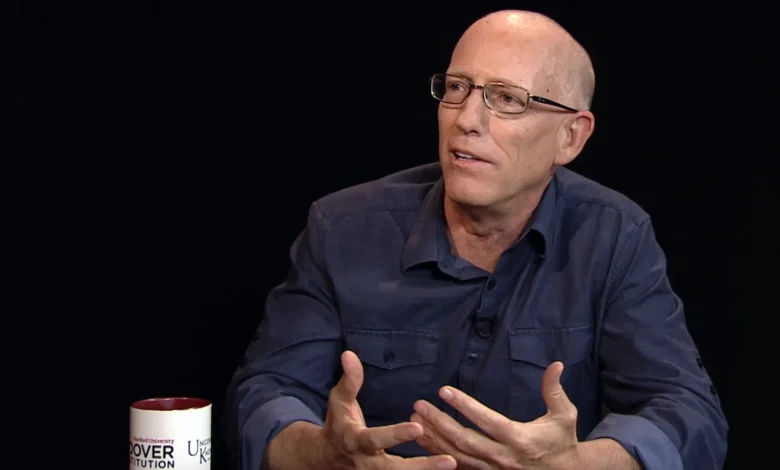
Scott Raymond Adams (1957–2026) was an American cartoonist, author, entrepreneur, and cultural commentator best known for creating Dilbert, the globally syndicated comic strip that redefined office humor for millions of readers. Rising from a small-town childhood in upstate New York to international recognition, Adams built an unlikely career at the intersection of business, satire, and psychology. For more than three decades, Dilbert served as a mirror for corporate life capturing cubicle frustrations, managerial absurdities, and workplace dynamics with a blend of wit, cynicism, and insight that resonated across industries and continents.
Beyond cartooning, Adams wrote best-selling business and personal-development books, experimented with entrepreneurial ventures, and later reinvented himself as a provocative online commentator with a devoted following. His life was marked by notable achievements, controversies, and public debates that elevated him from entertainer to cultural figure. In his final years, Adams confronted debilitating health challenges and a highly public battle with metastatic cancer, remaining outspoken and active until his death in January 2026. His legacy remains complex: celebrated for pioneering workplace satire and criticized for racism commentaries, yet unquestionably influential in shaping the modern language of office culture and persuasion.
Scott Adams Family and Early Life
Scott Adams was born in a small town called Windham in upstate New York. His father, Paul Adams, worked in a post office and sometimes painted houses to earn extra money. His mother, Virginia Adams, stayed at home for some years, and later worked in real estate and also in a factory.
Scott grew up in a quiet, cold town surrounded by mountains. Later in life, he joked that the area felt like a “frozen tundra” because of its long, snowy winters. During college, he experienced a very bad snowstorm, which helped him decide that he wanted to move to California, where the weather was warmer.
Scott became interested in drawing when he was very young. He loved reading comic strips like Peanuts in newspapers. By the time he was about six years old, he had already started making his own cartoons. When he was eleven, he joined an art course by mail and took part in a drawing contest. One art school said he was too young, but the experience still encouraged him and made him want to become a cartoonist in the future.
Scott Adams Education
Scott Adams went to Windham–Ashland–Jewett Central School for high school and finished in 1975. He graduated at the top of his class, which means he was the valedictorian. His class was small, with only about 39 students.
After high school, he went to Hartwick College in Oneonta, New York. He studied economics and finished with a college degree in 1979.
Later, Scott continued his studies while working full-time. He went to the University of California, Berkeley, in the Haas School of Business, where he earned a Master of Business Administration (MBA) in 1986.
These studies helped him understand business, money, and management. This knowledge later inspired many parts of his comic strip Dilbert and the books he wrote about work and success.
Scott Adams Early Corporate Career (Before Dilbert)
Before Scott Adams became a full-time cartoonist, he worked in regular office jobs for more than ten years. These jobs later gave him many ideas for his comic strip Dilbert.
Scott started working at a bank as a teller. While working there, he was robbed at gunpoint two times in just a few months, so he switched to a different job inside the bank. Over the years, he had many office roles, such as trainee, computer programmer, budget planner, business lender, product manager, and supervisor.
Later, Scott worked at a big phone company called Pacific Bell. He worked with engineers and spent his days in meetings and cubicles. During this time, he woke up very early (around 4 a.m.) to draw Dilbert before work, and sometimes even drew comics on his office whiteboard.
His office experiences—cubicles, meetings, bosses, and company rules—inspired the jokes, ideas, and situations that made Dilbert famous later on.
Scott Adams Creation and Rise of Dilbert
Scott Adams began drawing the comic strip Dilbert in the late 1980s. He wanted to make a funny comic about what life is like for office workers.
How Dilbert was created:
- The main character, Dilbert, was created to be an ordinary office worker who faces the everyday problems and frustrations that many people in offices feel.
- The name “Dilbert” was suggested by one of Scott’s old bosses, Mike Goodwin.
- Another character, Dogbert, was inspired by Scott’s own pet dog, a beagle named Lucy.
Getting published for the first time:
- Dilbert was first introduced to newspapers in 1989. This means that a company called United Media agreed to share the comic with many newspapers.
- At first, Dilbert didn’t get a lot of attention. Scott changed the strip slightly based on what readers seemed to like. He focused more on Dilbert’s work life instead of his home life, and as a result, the comic began to become more popular.
Growing very popular:
- By the mid-1990s, Dilbert was published in hundreds of newspapers.
- Around the year 2000, Dilbert was being printed in about 2,000 newspapers in 50–70 countries and in many different languages.
- Many workers who felt frustrated at their jobs enjoyed the comic because it made fun of common corporate problems, like pointless meetings, confusing rules, and bosses who didn’t understand their employees.
Becoming a full-time cartoonist:
- Because Dilbert became so successful, Scott Adams decided to stop working at his office job at Pacific Bell in 1995. After that, he worked full time as a cartoonist.
Books, TV, and merchandise:
- Dilbert was printed in many books and calendars that people could buy.
- Scott wrote a popular book about work and management called The Dilbert Principle in 1996. It became a bestseller and was widely read by business people.
- There was even a Dilbert TV show that aired on the UPN network from 1999 to 2000. It ran for two seasons and was nominated for an Emmy Award.
- The characters and style of Dilbert also appeared on many products, like toys, mugs, posters, and more.
Awards and recognition:
- In 1997, Scott Adams won the Reuben Award from the National Cartoonists Society. He was named Outstanding Cartoonist of the Year and also won for Best Newspaper Comic Strip.
- Time Magazine listed Dilbert or Scott Adams as one of the important and influential figures in the late 1990s.
- His ideas were also recognized in lists of business and management thinkers in the 2000s.
In addition to Dilbert, Scott Adams was a successful author and entrepreneur who explored many ideas beyond cartooning. He wrote a number of books about business, work, and life, often using humor to explain smart ideas. His best-known book, The Dilbert Principle, joked that companies sometimes promote bad workers into management to stop them from doing real work and it became a bestseller. He followed that with other titles like Dogbert’s Top Secret Management Handbook, The Joy of Work, and How to Fail at Almost Everything and Still Win Big, in which he talked about how learning from failure can lead to success. Scott also tried writing fiction. His books God’s Debris and The Religion War explore big questions about life, belief, and how people think, and he once said these might be the works people remember most of all.
Scott didn’t stop at writing. In 1999, he started a business called Scott Adams Foods, Inc. and launched a healthy vegetarian product called the Dilberito a microwaveable burrito named after his famous character. He hoped it would become as popular as blue jeans, but it never sold well and the company eventually closed. Even though the food venture failed, it showed Scott’s willingness to take risks and try new things beyond the comic page.
Scott Adams Media and Political Comments
Starting in the mid-2010s, Scott Adams became well-known for talking about politics and culture, not just for drawing comics. He used blogs, social media, livestreams, and podcasts to share his thoughts.
Around 2015, Scott wrote a lot about Donald Trump’s communication style. He argued that Trump used special persuasion skills and predicted that Trump would win the 2016 U.S. election for that reason. This made Scott more popular, but it also brought him more critics.
Scott launched a daily livestream and podcast called “Real Coffee with Scott Adams.” It first appeared on platforms like Periscope and YouTube, and later on platforms like Locals. On this show, he talked about politics, news, how people think, and sometimes shared personal stories from his own life. He also invited guests from technology, politics, and media.
Scott did not place himself strictly on one side politically. At different times, he said he leaned libertarian and liked practical ideas from both the left and the right. He publicly supported Mitt Romney in 2012 and Donald Trump in 2016. Scott later said that supporting Trump caused problems for him socially and hurt his speaking career, but he believed in saying what he truly thought.
Scott Adams Criticism on Racism
In the 2010s and 2020s, Scott Adams began to attract a lot of criticism for some of the things he said online about race, gender, and politics. Many people thought his words were insensitive, offensive, or harmful, especially when he talked about groups of people based on their race.
The biggest controversy came in February 2023. During a livestream of his show Real Coffee with Scott Adams, he reacted to a poll and made comments about Black Americans, calling them a “hate group” and saying that white people should “get the hell away from Black people.” Many people and news outlets described these remarks as racist.
Because of those comments:
- Many newspapers stopped running Dilbert.
- His comic’s distributor (Andrews McMeel Syndication) ended their relationship with him.
- His book publisher also dropped plans to publish his upcoming book.
Scott said later that he was using exaggeration and that he didn’t mean to be racist, but many media companies and critics still saw his comments as harmful.
After losing most newspaper support, Adams continued Dilbert online under a new name, “Dilbert Reborn,” and focused more on his own platforms where he still had a smaller following.
Scott Adams Personal Life and Marriage
Scott Adams was married twice.
- His first marriage was to Shelly Miles on July 22, 2006. They got married on a yacht in San Francisco Bay.
- Scott became a stepfather to Shelly’s two children, Savannah and Justin.
- Sadly, Justin died in 2018 from a fentanyl overdose when he was only 18 years old. Scott talked openly about this loss in his writing and on his podcast.
- Scott and Shelly later divorced in 2014, but they remained friendly. She continued living nearby in Pleasanton, California.
- His second marriage was to Kristina Basham.
- Scott announced they were engaged on his podcast in December 2019.
- They got married on July 11, 2020. Kristina is a model, baker, and tech executive, and she had two daughters from a previous relationship.
- They divorced in March 2022.
Scott did not have any biological children, but he was a stepfather in both marriages.
Scott lived for many years in Pleasanton, California, which is in the San Francisco Bay Area.
Scott learned hypnosis and often spoke about using affirmations and visualization to help him reach his goals — like getting into business school and succeeding with Dilbert.
Near the end of his life, Scott said he planned to convert to Christianity, and he explained this as a choice he felt could bring personal and practical benefits.
Scott Adams Sickness and Disabilities
Scott Adams dealt with serious health problems for many years, and these problems affected both his drawing and his ability to speak. Even with these challenges, he kept working and found new ways to continue his career.
Focal dystonia (hand and arm):
In the early 1990s, Scott began to have strange muscle spasms in the little finger of his drawing hand. The finger would curl or lock up whenever he tried to draw. Doctors told him he had a condition called focal dystonia, which is a neurological disorder that can happen when certain muscles are overused. For a while, Scott said he managed to control the problem with special exercises, but the condition became worse again in the mid-2000s. It made drawing painful and limited how long he could work.
Because of this, Scott changed the way he created his comics. Around 2014, he began using a graphics tablet instead of drawing on paper. He also taught himself to draw with his left hand instead of his right hand. This allowed him to keep making comics even though his original drawing hand could no longer work normally.
Spasmodic dysphonia (voice):
Scott also developed a second neurological condition called spasmodic dysphonia, which affects the vocal cords. This disorder caused his voice to break, strain, or disappear when he tried to speak. For several years, Scott could barely talk at all, which made interviews, public speaking, and everyday communication very difficult.
In 2008, Scott had a surgery where doctors rerouted some of the nerves that controlled his vocal cords. After this operation, he regained much of his voice. Once his speech improved, he used his voice frequently on his podcast, livestreams, and interviews. He also spent time raising awareness about spasmodic dysphonia so that more people would learn about the condition and understand its effects.
Scott Adams Cancer and Final Illness
In May 2025, Scott Adams told his audience that he had been diagnosed with prostate cancer that had spread to other parts of his body, including his bones. This means the cancer had become very serious and could not be cured.
Scott said the cancer was very painful and that doctors told him his chances of getting better were almost zero. He used a walker because the pain made it hard to walk, and later the cancer affected his spine, which caused even more serious problems with movement.
As the months passed, Scott’s condition got worse. He shared updates on his show and told fans that his legs had lost feeling and that he was also dealing with heart problems. He said he was preparing for what would happen next and encouraged his followers to understand how serious his illness was.
Scott spent his last weeks in hospice care, which is special care for people who are very close to the end of life. He stayed at his home in Pleasanton, California, where his family and friends helped take care of him.
Scott Adams Death
Scott Adams died on January 13, 2026, at the age of 68. His first ex-wife, Shelly Miles, announced his death during a livestream on his show. She read a farewell message that Scott had written on January 1, 2026. In that message, he said he had given his life everything he had and thanked people for their support.
His death was caused by prostate cancer that had spread throughout his body. Many news outlets reported on his passing, sharing his impact as the creator of Dilbert and his long fight with illness.
Even in his final days, Scott stayed connected with his audience and continued to speak openly about his health, his work, and his life. His passing marked the end of a long career that touched millions of readers around the world.
A Final Message From Scott Adams
In the days before his death, Scott Adams wrote a farewell message that was published on his social media and read aloud by his ex-wife during a livestream. In that message, he spoke directly to his readers and supporters one last time.
health, saying that his body had failed before his brain but that he was still of sound mind as he wrote the message on January 1, 2026. He told people that if they were reading the message, it meant things had not gone well for him and that he wanted to share a few final thoughts before he passed.
He said that he had given his life everything he had, and expressed gratitude for the experiences he’d had, the work he produced, and the people who had followed his career over the years. Adams reflected on his life’s journey — including his creative work, his books, his comic strip Dilbert, and the connections he’d made with his audience.
In parts of the message reported by news outlets, Adams also shared moments of personal meaning and acceptance, including thoughts about faith and Christianity that he embraced near the end of his life. He expressed a hope of being qualified for entry into heaven and spoke about faith in simple, heartfelt terms, calling it a meaningful part of his final chapter.
Finally, Adams encouraged readers to “be useful” — a phrase he had used often late in life to describe his own goals — and to live their lives with purpose. While his health had declined, and his career had gone through ups and downs, he closed his message with a sense of acceptance and thanks for his fans and supporters.
Scott Adams Net Worth
Scott Adams earned money in many ways during his life. He became well-known and successful mainly because he created the comic strip Dilbert, which was published in newspapers around the world for many years. He also made money from books, merchandise, a TV show, and speaking appearances.
As of 2025, estimates from business and celebrity finance websites show that Scott Adams had a net worth of about $20 million. This means that the total value of his money, property, and earnings from his work was around twenty million US dollars near the end of his life.
Most of this money came from:
- Syndication earnings from Dilbert being published in newspapers internationally.
- Book sales and publishing deals.
- Merchandise and TV royalties from the Dilbert animated series and licensed products.
Even after controversy reduced his mainstream publishing income later in life, Dilbert remained one of the most financially successful comic strips of its generation, and Scott Adams stayed financially comfortable due to years of steady earnings from his creative work.
Conclusion
Scott Adams lived a life filled with creativity, risk-taking, and strong opinions. He became famous for Dilbert, a comic strip that made millions of office workers laugh and feel understood. Through his books, business ventures, livestreams, and online posts, he continued to share his ideas about work, success, and how people think.
Even though he faced controversy and criticism in his later years, he also continued to speak honestly and directly to his audience. His health challenges showed his determination, as he kept working and communicating even when his voice, his hands, and later his whole body made life hard.
Scott’s final message showed that he wanted people to live with purpose and to make good use of their time. His life reminds us that creativity can come from ordinary places, that success often starts with failure, and that our voices can reach far when we are willing to share them. Through his comics, books, and ideas, Scott Adams left a legacy that will continue to influence readers, workers, and thinkers long after his passing.
Frequently Asked Questions About Scott Adams
1. How old was Scott Adams?
Scott Adams died at the age of 68 on January 13, 2026. He was born on June 8, 1957 in Windham, New York.
2. Was Scott Adams a supporter of Donald Trump?
Yes. Scott Adams was known for his support of Donald Trump and for writing and speaking about Trump’s communication and persuasion strategies. In November 2025, Adams publicly asked for Trump’s help with expediting his cancer treatment, and Trump responded.
3. Who was Scott Adams’s wife?
Scott Adams was married twice: first to Shelly Miles (married in 2006, divorced in 2014), and later to Kristina Basham (married in 2020, divorced in 2022).
4. What was Scott Adams’s net worth?
Public estimates widely reported that Scott Adams had a net worth of about $20 million by the time of his death. His income came from his Dilbert comic strip, books, television work, and business ventures.
5. Is there discussion about Scott Adams on Reddit?
Yes. After the news of his death at age 68 and his controversial life, users on Reddit’s r/news and other subreddits discussed his legacy, Dilbert, and his political commentary.
6. What was the “Scott Adams letter” or his final message?
Before he died, Scott Adams wrote a farewell message that was read publicly by his ex-wife on his livestream. In it he reflected on his life, career, and shared thoughts on meaning and purpose. The statement was later published on social media.
7. Is Scott Adams dead?
Yes. Scott Adams died on January 13, 2026 after a battle with metastatic prostate cancer that had spread to his bones. His death was announced by his ex-wife, Shelly Miles.
8. What books did Scott Adams write?
Scott Adams wrote many books, including:
- The Dilbert Principle (management satire)
- Win Bigly (about persuasion and Donald Trump)
- How to Fail at Almost Everything and Still Win Big
- God’s Debris (philosophical fiction)
- The Religion War (fiction)
He also published Dogbert’s Top Secret Management Handbook, The Joy of Work, and others tied to Dilbert and business topics.