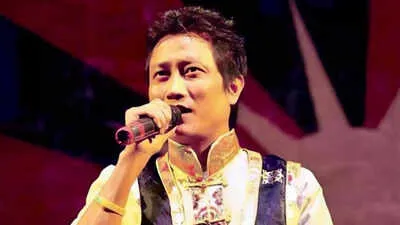
Prashant Tamang’s journey from the mist-covered hills of Darjeeling to the full glare of national stardom is one of the most remarkable success stories in contemporary Indian entertainment. Born into a modest Nepali-speaking Gorkha family in West Bengal, his early life offered none of the celebrity privileges. Instead, his childhood was shaped by the daily life of a close-knit hill community, the demands of family responsibility, and a love for music that revealed itself long before he ever stepped onto a professional stage.
What distinguished Prashant was not merely talent, but the quiet discipline and resilience that defined him from a young age. After the untimely death of his father, he stepped away from full-time education to support his family through service in the Kolkata Police a decision rooted in duty rather than ambition. Yet destiny had other plans. The same boy who once sang at school programs and community gatherings would later command national attention on one of India’s biggest reality television platforms.
His explosive rise began with Indian Idol Season 3, where his calm stage presence, earnest voice, and unpolished authenticity resonated with millions. What followed was more than a contest it became a cultural phenomenon. As Nepali-speaking Gorkhas across India and abroad rallied behind him, Prashant became a living emblem of regional pride, representation, and collective aspiration. When he ultimately won the title in 2007, he crossed a symbolic threshold: from unknown artist to music icon, from the hills of Darjeeling to the living rooms of a nation.
That victory did not merely alter his own destiny; it rewrote the narrative for countless young artists from smaller towns who dared to dream beyond geography. In the years that followed, Prashant expanded his influence into music, cinema, and eventually on-screen acting each milestone reinforcing the arc of a career born in the mountains but forged at the center of India’s cultural mainstream.
Prashant Tamang Roots and Childhood: A Humble Beginning in the Hills
Prashant Tamang was born on 4 January 1983 in Darjeeling, a hill town perched along the eastern Himalayas of West Bengal. The region, known for its tea gardens and steep winding streets, was also home to a vibrant Nepali-speaking Gorkha community whose culture, language, and music formed the backdrop of Prashant’s upbringing. His family lived modestly, grounded in the values of discipline, quiet resilience, and mutual dependence that defined life in the hills.
He grew up as the only son of Madan Tamang, a sepoy in the Kolkata Police, and Rupa (Indira) Tamang, a homemaker who nurtured the family. Prashant also shared a close bond with his elder sister Archana and his grandmother, who played a formative role in his early years. Like many children in Darjeeling, he attended St. Robert’s School, balancing schoolwork with football matches, local festivities, and endless hours of singing sometimes with friends, sometimes alone, and often without realizing that music would one day become his life’s central force.
What shaped Prashant Tamang during childhood was the environment itself. Darjeeling, with its mixture of ethnicities and languages, had a tradition of informal music; guitars at picnics, community singing at festivals, and spontaneous performances at school events. Prashant absorbed this world effortlessly. He never went through the rigors of classical or institutional training; instead, his voice developed in living rooms, school halls, and open-air gatherings where melody mattered more than technique. His early fascination with rhythm saw him drumming on tables, tapping beats on books, and singing with a rawness that later became his signature.
Those were quiet years, not marked by any remarkable ambition toward fame, but rich in the cultural textures that shaped his identity. He was a boy of the mountains; observant, soft-spoken, and driven more by duty and affection than by personal ambition. No one could have predicted that the same boy who blended into the familiar rhythms of hill-town life would eventually command a large following. Yet the foundation of his future stardom was already there: an authentic voice, a natural ease with music, and a rootedness that would later become central to his public image.
Prashant Tamang Loss and Responsibility: Duty Before Ambition
The turning point in Prashant Tamang’s youth arrived with sudden tragedy. His father, Madan Tamang, died in an accident while still in service with the Kolkata Police. In the wake of that loss, childhood vanished quickly, replaced by the weight of responsibility that fell upon him as the only son of the family. For most teenagers, the future is shaped by aspiration; for Prashant, it was shaped by duty as the first son.
With his father gone and finances uncertain, Prashant made a decision that defined his early adulthood. He left formal education behind and entered public service, joining the Kolkata Police on compassionate grounds to take up the post his father could no longer fill. It was not a decision driven by personal desire but by the necessity of supporting his mother, sister, and grandmother; an act that reflected the values he was raised with: loyalty, humility, and familial obligation.
In Kolkata, far from the cool Himalayan air of Darjeeling, Prashant Tamang adapted to the demanding rhythms of city life. He learned to navigate the discipline of uniformed service, the hierarchy of the police department, and the stark contrast between the hill town he came from and the sprawling metropolis he now served. Through it all, music remained his quiet refuge. Within the force, he was assigned to the police orchestra, where his voice finally had a platform beyond school gatherings and community events. He sang at official functions, police ceremonies, and civic gatherings, slowly building confidence yet still far from imagining a professional career as a singer.
Those years in uniform did more than provide income; they forged Prashant’s character. Patrolling the streets, handling routine duties, and performing at official engagements taught him discipline, steadiness under pressure, and respect for ordinary people themes that would later shape his public persona. He remained humble, grounded, and relatively unknown outside musical circles within the police force.
In retrospect, this period was unlikely preparation for stardom, but it was precisely this experience that made Prashant stand out when his moment finally arrived. He was not a product of reality-TV grooming or show-business culture. He was a working-class constable who sang because it was the language through which he expressed himself.
The Indian Idol Wave: A Movement Larger Than the Show
Prashant Tamang’s leap from anonymity to Fame began in 2007, almost by accident. Encouraged by colleagues and seniors in the Kolkata Police—many of whom had witnessed his performances with the police orchestra—he auditioned for Indian Idol Season 3, one of India’s most-watched singing competitions at the time. For a young constable with no formal musical training, the decision was both bold and improbable. Yet from the moment he stepped onto the audition stage, his calm presence and emotive vocals set him apart.
On the show, Prashant was not a flamboyant performer in the conventional sense. He didn’t rely on stage theatrics or vocal acrobatics; instead, he sang with sincerity, restraint, and an unmistakable humility that resonated with audiences across linguistic and regional lines. Week after week, he survived eliminations, often receiving critiques that were measured. But beyond the studio walls, something extraordinary was unfolding.
What started as a singing contest soon transformed into a cultural movement. The Nepali-speaking Gorkha community spread across Darjeeling, Sikkim, the Northeast, the Dooars, Kolkata, and large diasporic pockets in the Middle East, the UK, Hong Kong, Brunei, and beyond rallied behind him with unprecedented unity. Voting drives were organized, community funds were raised, and supporters mobilized on a scale rarely seen for any reality-show contestant. For them, Prashant was not merely a competitor; he was a symbol of identity, dignity, and long-overdue representation on national television.
His success on the show became a point of collective pride. The quiet constable from the hills carried the aspirations of a community historically absent from mainstream Indian entertainment. By the time the finale arrived, the wave had become unstoppable. Prashant emerged as the winner of Indian Idol 3, defeating finalist Amit Paul in one of the most talked-about seasons of the franchise. His victory came with a cash prize, a new car, and above all, national recognition.
But the deeper impact was cultural. Prashant Tamang’s win signaled that talent could emerge from places outside Mumbai and Delhi, that mainstream Indian media could be reshaped by voices from the margins, and that audiences were ready to champion authenticity over industry polish. In the months that followed, he returned to Darjeeling to scenes reminiscent of a state visit: crowds filled the streets, banners waved from rooftops, and the hills reverberated with music, cheers, and tears of pride.
Indian Idol had done more than crown a winner it had introduced the nation to an artist whose journey embodied resilience, representation, and the power of collective belief. It also set the stage for Prashant’s evolution from television sensation to recording artist, film actor, and eventually a multifaceted artist whose influence extended across borders.
Prashant Tamang Music Beyond Reality Television: Crafting a Post-Idol Career
Winning Indian Idol catapulted Prashant Tamang into celebrity status, but it also presented a challenge familiar to reality-show champions: how to convert short-term visibility into a sustainable artistic career. For Prashant, the answer lay not in reinventing himself, but in expanding the musical identity that had made him beloved in the first place; simple, heartfelt, and grounded in regional culture.
His first major professional milestone after the show was the release of his debut album “Dhanyavad”, produced under Sony BMG. The title meaning “thank you” was more than symbolic; it acknowledged the grassroots movement that had propelled him to victory, and it aligned Prashant with the Nepali-speaking and pan-Indian fan base that had formed his bedrock. The album featured a mix of Nepali and Hindi tracks, allowing him to honor both his cultural roots and his national audience.
Live performance quickly became central to his post-Idol identity. Throughout the late 2000s and early 2010s, Prashant embarked on a series of concert tours across India, Nepal, the Middle East, Southeast Asia, the UK, and other diaspora centers, consistently drawing crowds that treated his shows as cultural events as much as musical ones. He was not a studio-bound artist chasing the charts; he was a touring singer who thrived on direct engagement with audiences. Concert promoters regularly noted the unusual demographic mix at his shows: young fans, older Gorkha families, Indian Idol viewers, and non-Gorkha audiences drawn by his sincerity and stage warmth.
He also entered the regional film and music circuit, contributing playback vocals to Nepali cinema. These projects helped him consolidate his position as a cross-border figure who belonged simultaneously to Indian mainstream entertainment and to the Nepali cultural sphere. His voice, characterized by an honest emotional timbre rather than technical ornamentation, made him particularly suited to romantic ballads and patriotic compositions, both of which became staples of his repertoire.
For Prashant, the years after Indian Idol were not defined by attempts to chase Bollywood stardom an avenue many expected him to pursue but by a steady cultivation of a cultural niche that had commercial viability and deep emotional resonance. He built his career on authenticity, diaspora connection, and regional pride, rather than on industry publicity machinery. This approach gave him longevity, allowing him to remain relevant long after television fame would typically fade.
By the mid-2010s, he was widely recognized not merely as “the Indian Idol winner,” but as a respected artist in his own right a singer who had carved out a transnational audience and avoided the pitfalls that had swallowed many reality-show champions before him. His musical journey laid the foundation for his next major transformation: the transition into acting, where he would once again defy expectations.
From Stage to Screen: Cinema, Character, and Reinvention
As Prashant Tamang’s musical career matured, he embarked on a transition that surprised many observers: a move into acting. For a singer with no formal theatre background, the Nepali film industry became an unexpected platform for reinvention. Yet the qualities that defined him as a performer; restraint, sincerity, and emotional clarity translated seamlessly to the screen.
His acting debut came with “Gorkha Paltan”, a war-themed Nepali-language film released in 2010. The role aligned naturally with his public persona: dignified, understated, and rooted in the lived experiences of Gorkha soldiers and their families. The film performed strongly across Nepali-speaking regions, and audiences responded warmly to Prashant’s quiet screen presence. He did not attempt to mimic mainstream Bollywood flamboyance; instead, he leaned into a more grounded realism that became his hallmark.
Following the film’s success, he went on to star in projects such as “Angalo Yo Maya Ko,” “Kina Maya Ma,” “Nishani,” “Pardesi,” and “Ye Maya Hannaima.” These films spanned romance, drama, and patriotism genres that allowed him to explore a wider emotional range while maintaining the gentleness and masculine restraint his fanbase cherished. His portrayal in “Nishani,” centered on the lives of Gorkha soldiers, and “Pardesi,” a film focused on diaspora longing and cross-border identity, earned him particular affection among Nepali-speaking communities both inside and outside Nepal.
While he never positioned himself as a conventional “star” chasing box-office dominance, Prashant’s film choices built a regional cinematic legacy that spoke to the cultural stories he understood best. In interviews and public appearances, he often emphasized pride in his heritage, expressing that cinema offered him a way to represent the struggles and triumphs of ordinary people from the hills—people like the ones he grew up with.
A significant turning point came years later, when he made a return to national visibility through the streaming boom. In 2025, Prashant appeared in “Paatal Lok” Season 2, the critically acclaimed Prime Video series that had already established itself as a benchmark for gritty Indian storytelling. Cast as Daniel Acho, a near-silent sniper whose scenes were defined by tension rather than dialogue, Prashant delivered a sharp and controlled performance that startled audiences familiar only with his musical persona. He conveyed menace through stillness, precision through gesture, and narrative weight without leaning on spoken lines—a testament to how far he had come from the modest stages of his police orchestra days.
By the time of his passing, Prashant Tamang had established himself as a multi-dimensional artist a singer, a film actor, and an OTT performer whose career consistently defied the narrow expectations placed upon him. He proved that a man from the mountains, raised in ordinary circumstances and driven by duty, could navigate multiple artistic worlds without losing his authenticity. His cinematic journey did not overshadow his music, nor was his music diminished by his screen roles; instead, they expanded his legacy and deepened the imprint he left on audiences across borders.
Prashant Tamang Love, Marriage, and Fatherhood
Behind Prashant Tamang’s public story as a singer and actor was a quieter story of companionship and family one that unfolded far from stage lights, press interviews, and fan movements. Despite the scale of his fame in certain cultural circles, Prashant remained an intensely private individual when it came to his personal life. He preferred to let the public engage with his work rather than his domestic life, a boundary he maintained consistently throughout his career.
Prashant married Martha Aley (also known as Geeta/Geeta Thapa), a flight attendant, after the two crossed paths during his travels. Their relationship was grounded in privacy, and their wedding held in the early 2010s was marked not by celebrity fanfare but by familial warmth and cultural tradition. To Prashant, marriage represented stability rather than publicity. Martha offered companionship without demanding a share of the spotlight he occupied, and Prashant valued the sanctuary that provided.
In July 2022, their family grew with the birth of their daughter, Ariah Tamang. Fatherhood revealed a new dimension to Prashant’s personality one that was tender, playful, and deeply engaged. Videos and personal moments shared sparingly after his passing showed him singing softly with his young daughter, cradling her during quiet afternoons, or simply letting her climb across his lap as he strummed a guitar. Fans who had known him as a musician first and an actor second were struck by these glimpses into his role as a father, where his public poise gave way to relaxed affection.
Family life anchored Prashant more firmly than any award or performance. While his career took him to foreign tours, film sets, and OTT productions, his emotional center remained at home with his wife, his child, and his extended relatives in Darjeeling and beyond. He maintained close bonds with his mother, sister, and grandmother, carrying with him a sense of duty that never wavered despite geographical or professional distance.
Prashant Tamang Final Days and Passing
On 11 January 2026, the entertainment world received the shocking news of Prashant Tamang’s untimely passing at the age of 43. The beloved singer and actor was found unresponsive at his residence in New Delhi, where he had been living while actively working on performances and screen projects. Reports from multiple news outlets state that he suffered a sudden cardiac arrest, leading to his death early that morning. Despite being rushed to a nearby hospital in Dwarka, he was declared dead on arrival, leaving family members, friends, and fans in profound grief.
While the precise medical cause awaited confirmation through an official post-mortem, the overwhelming weight of early reporting and statements from associates pointed to a cardiac event as the immediate cause. Some accounts also referenced the possibility of a stroke, reflecting how rapidly the emergency unfolded at his home.
Prashant’s wife, Martha Aley, publicly addressed reactions to his death, describing it as a natural death that occurred in his sleep and expressing deep gratitude for the global outpouring of support. Her statement reaffirmed that there was no indication of foul play, emphasizing that his passing was a devastating but natural medical event.
The news of Prashant’s death triggered widespread mourning across India, Nepal, and within the global Gorkha community. Fellow artists, former Indian Idol contestants, and fans shared tributes and memories, highlighting his exceptional journey from humble beginnings to national and international recognition. Political figures and cultural leaders also acknowledged his contribution to music and representation for hill-region communities, reflecting the broad impact of his life and career.
Prashant Tamang Net Worth
At the peak of his career, Prashant Tamang’s net worth was widely estimated at US$1.97 million (approximately ₹16–17 crore). This valuation reflects nearly two decades of sustained artistic work across multiple mediums, including music, live performance, and on-screen acting. His earnings began with his landmark Indian Idol Season 3 victory, which brought not only public recognition but also a significant financial foundation through prize money and material awards.
Subsequent income came from:
- Concert and live-show circuits in India, Nepal, the Middle East, Southeast Asia, Europe, and other diaspora hubs, where Prashant built a strong cultural following that translated into consistent performance fees.
- Music releases and playback singing, especially in Nepali-language cinema and regional projects that appealed to transnational Nepali-speaking audiences.
- Film acting, with roles in Nepali cinema across drama, romance, and military-inspired narratives.
- OTT and television work, including his re-emergence before national audiences through major streaming productions late in his career.
While he remained a modest public figure who did not indulge heavily in ostentatious display, Prashant’s financial stability allowed him to provide security for his family and to invest in a career built on authenticity rather than commercial sensationalism. By the time of his passing, his net worth stood as evidence of both his artistic longevity and his strategic ability to translate cultural influence into a viable financial legacy.
Prashant Tamang Legacy
Prashant Tamang’s legacy extends far beyond music competitions or screen performances. His journey reshaped how entire communities imagined themselves within the broader Indian narrative, proving that popular culture could accommodate voices from regions and identities long pushed to the margins. At the heart of this legacy is representation: when he appeared on Indian Idol, he carried with him more than a singing voice—he carried the lived experiences of Nepali-speaking Gorkhas across India and the diaspora. His ascent became a historic moment of visibility for a community that had contributed to India’s cultural, athletic, and military fabric yet remained largely unseen in mainstream entertainment.
Artistically, Prashant demonstrated that alternative pathways to success were not only possible but sustainable. Without conservatory training, elite industry networks, or Bollywood backing, he built a career through regional strength, diaspora connection, and the enduring power of live performance. His concerts resembled cultural gatherings that united families, while his acting roles gravitated toward themes of soldiers, diaspora identity, and the emotional landscapes of hill communities. His presence in Nepali-language cinema and later on OTT platforms showed that regional artists could enter national spaces without abandoning authenticity, reinforcing his status as a bridge between Indian and Nepali artistic spheres.
Beyond art and representation, Prashant became a symbol of aspiration and social mobility. His background as a police constable, his interrupted education, and his working-class roots made his success relatable to young people from smaller towns and non-metropolitan regions. His sudden passing at 43 deepened the cultural resonance of his story, sparking memorials across India, Nepal, and the diaspora. Today, his legacy rests on three enduring pillars: cultural representation, artistic authenticity, and inspiration across borders. His voice continues to circulate online, his films remain part of Nepali cinema, and his Indian Idol performances introduce him to new generations—reminding millions that greatness often arrives quietly, shaped by humility, perseverance, and the power of belonging.
Conclusion
Prashant Tamang’s life traced an arc that feels almost mythic in its simplicity: a child of the mountains shaped by modest means, a young man thrust prematurely into responsibility, and an artist discovered almost by accident who went on to change how entire communities saw themselves. From the school halls of Darjeeling to the disciplined duties of a Kolkata Police constable, from the dazzling stage of Indian Idol to Nepali cinema and global OTT platforms, Prashant carried with him a steadiness that never wavered. He did not chase fame at the expense of his roots; instead, he allowed success to pass through the filter of his identity, heritage, and values, leaving behind a legacy that was cultural as much as it was artistic.
His sudden passing at 43 ended a journey that still felt full of possibility, leaving a daughter too young to grasp her father’s impact, a wife burdened with grief under public gaze, and a global community stunned by the loss of a symbol they had rallied behind. Yet even in absence, his presence remains—through his music, his acting, and the pride he inspired in Nepali-speaking Gorkhas and beyond. If the measure of a life lies not only in achievements but in what one awakens in others, Prashant stands as a testament to representation, humility, and perseverance. His story endures not because of tragedy but because of triumph, reminding a diverse nation that greatness does not always announce itself loudly; sometimes it arrives quietly, shaped by duty, compassion, and the belief that even the humblest beginnings can lead to extraordinary ends.
Frequently Asked Questions About Prashant Tamang
1. Who was Prashant Tamang?
Prashant Tamang was an Indian singer and actor known for winning Indian Idol Season 3 in 2007. He later built a successful career in music, Nepali-language cinema, and eventually OTT streaming platforms.
2. When and where was Prashant Tamang born?
He was born on 4 January 1983 in Darjeeling, West Bengal, India.
3. What was Prashant Tamang ethnic background?
Prashant belonged to the Nepali-speaking Gorkha community, a long-established minority within India with strong cultural ties across South Asia.
4. How did Prashant Tamang rise to fame?
He rose to national fame after winning Indian Idol 3, becoming a cultural symbol for Nepali-speaking Indians and Gorkhas worldwide.
5. Did Prashant Tamang have formal musical training?
No. Prashant did not receive formal musical training. His skills developed through school performances, community singing, and his role in the Kolkata Police orchestra.
6. What was his role in the Kolkata Police?
Before entering the entertainment industry, he served as a constable in the Kolkata Police, joining on compassionate grounds after his father’s death.
7. What movies did Prashant Tamang act in?
He appeared in several Nepali-language films including:
- Gorkha Paltan
- Angalo Yo Maya Ko
- Kina Maya Ma
- Nishani
- Pardesi
- Ye Maya Hannaima
8. Was he active on OTT platforms?
Yes. He gained renewed national attention through his role in Paatal Lok Season 2 on Prime Video.
9. Who was Prashant Tamang’s wife?
He was married to Martha Aley (also known as Geeta/Geeta Thapa), a flight attendant.
10. Did Prashant have children?
Yes. He had a daughter named Ariah, born in July 2022.
11. When did Prashant Tamang pass away?
Prashant passed away on 11 January 2026 at the age of 43.
12. What was the cause of his death?
Reports indicated a sudden cardiac arrest as the likely cause, with his wife publicly calling it a natural death that occurred in his sleep.
13. What was Prashant Tamang’s net worth?
Estimated net worth at his peak was approximately US$1.97 million (₹16–17 crore).